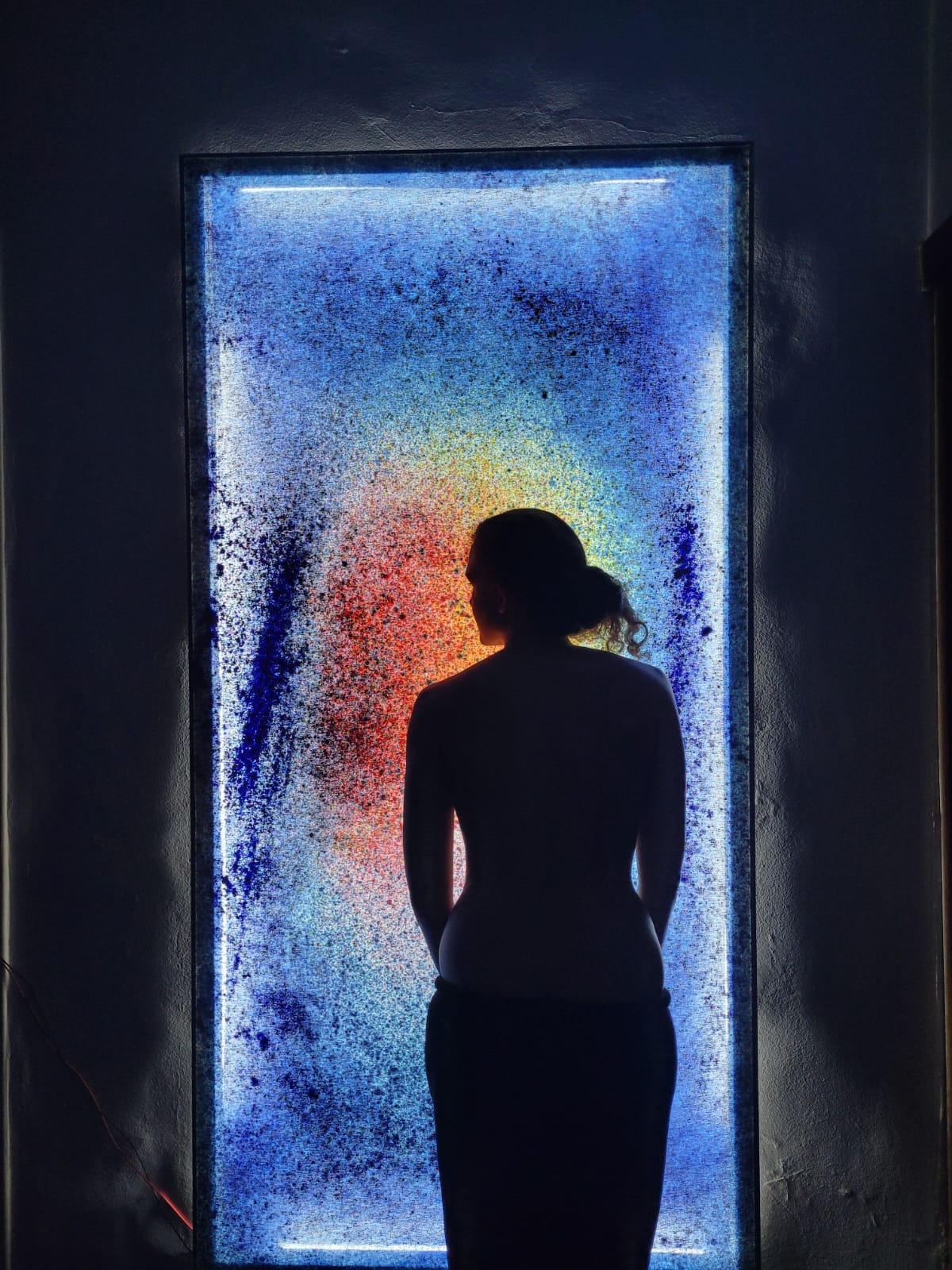
When a body appears, the painting changes.
Until that moment, it functions as an image.
It has its own logic, its depth, its tension.
But it remains contained.
With the body, that changes.
It becomes scale.
It becomes space.
It becomes a situation.
The figure is not there to represent anything.
It has no identity.
It is a minimal presence that allows us to measure what is occurring.
It is not someone looking at a work.
It is a body in front of a field.
Painting ceases to be a plane observed from a distance.
It draws near. It affects. It overflows the limit of the support.
Light does not illuminate the scene.
It envelops.
It defines and, at the same time, dissolves.
Matter is no longer perceived as something fixed.
It changes according to position, according to the path, according to the intensity of light.
The work does not end on the canvas.
It extends.
And within that extension, a different relationship appears.
Not of contemplation, but of presence.
The body does not complete the work.
It makes it unstable.
It introduces a measure that is not abstract.
A reference that does not organize, but rather creates tension.
What could previously be read as an image is now experienced as a situation.
Painting ceases to explain itself.
It becomes something that happens.
And at that point, distance disappears.
The work is no longer on the other side.
It begins to be inhabited.