My painting began as a surface, but more and more it behaves like a place. I am not interested merely in constructing images: I am interested in building sensitive territories, spaces where matter, light, and the body can enter into a relationship.
This search did not appear suddenly. It has a concrete origin: the isolation, the refuge, the boat, the Rincón Náutico, the need to transform a precarious space into a studio and to sustain a pictorial practice in the midst of the elements. During the pandemic, the act of painting ceased to be solely an artistic decision and became a form of permanence. To paint was to build a place when everything seemed suspended.
Since then, my work began to shift. Painting no longer wanted to remain enclosed within the frame as a frontal image. It began to ask for scale, body, path, darkness, light, distance, silence. It began to demand spatial conditions to unfold. The surface became insufficient because the work began to behave as an experience.
In this process, the refuge was the first model of an inhabitable work. The Sylene was not just a boat: it was a minimal architecture of survival, a floating border between the outside world and an intimate zone of resistance. The Rincón Náutico of the San Fernando Club island was not just a workplace either: it was the first untamed territory, a space where painting could appear without asking for permission, traversed by the river, the night, the humidity, the precariousness, and the necessity.
This experience still remains in my current research. It appears in Territories of the Last Song, where painting is organized as an extreme landscape, memory, collapse, and signal. It appears in Membranes / The Untamed Frontier, where the work ceases to be a fixed surface and becomes a threshold, skin, passage, and suspended body. It appears in Stellar Heartbeat, where light enters as living matter and painting begins to breathe in cycles of appearance and disappearance.
These works are not isolated projects. They are different forms of the same question: how to build a painting that is not only looked at, but traversed? How to make matter cease to be background and become presence? How to convert the image into territory, the canvas into membrane, and light into a heartbeat?
I am interested in thinking of painting as a sensitive architecture. An architecture that is not functional, but existential. A space where the viewer can come into contact with something that cannot be fully explained: a vibration, a loss, a force that insists, a signal against going dark.
In that direction, the work begins to expand toward increasingly complex formats: large surfaces, deep stretchers, suspended membranes, inhabitable structures, lighting devices, immersive paths, and systems where painting, body, and space can no longer be separated. Painting becomes environment. The work no longer ends at the edge of the canvas: it continues in the shadow, in the light, in the distance, in the way the body approaches or stops in front of it.
This displacement also implies a concrete need: production space. Not as a comfort, but as a condition for the work. There are projects that cannot be conceived solely from a desk, a domestic wall, or an improvised corner. They need real scale, assembly time, light tests, tension trials, distance to look, a place to make mistakes, correct, and rebuild.
The current research of my work needs this passage: from the frame to the territory, from the image to space, from painting as an object to painting as an inhabitable experience. It is not about abandoning painting, but about pushing it to its limit. Forcing it until it begins to behave as a refuge, a border, a body, a signal, and a presence.
That is why the idea of an inhabitable painting is not a formal whim. It is a natural consequence of my journey. It is born from isolation, from the boat, from the studio in the elements, from the Pandemic series, from the territories that still sing, from the membranes that separate and let through, from the lights that fade and ignite again.
An inhabitable painting is a work that is not content with being seen. It wants to surround, affect, contain, make uncomfortable, protect, and reveal. It wants to build an experience where the viewer is not in front of an image, but inside a tension.
My current work stands within that tension: between the primitive and the contemporary, between the cave and the device, between dark matter and the ignited signal, between the refuge and the elements.
Painting, for me, is building a territory where something of human sensitivity can resist.
A place to cross the limit.
A space where matter still breathes.
An untamed signal against going dark.
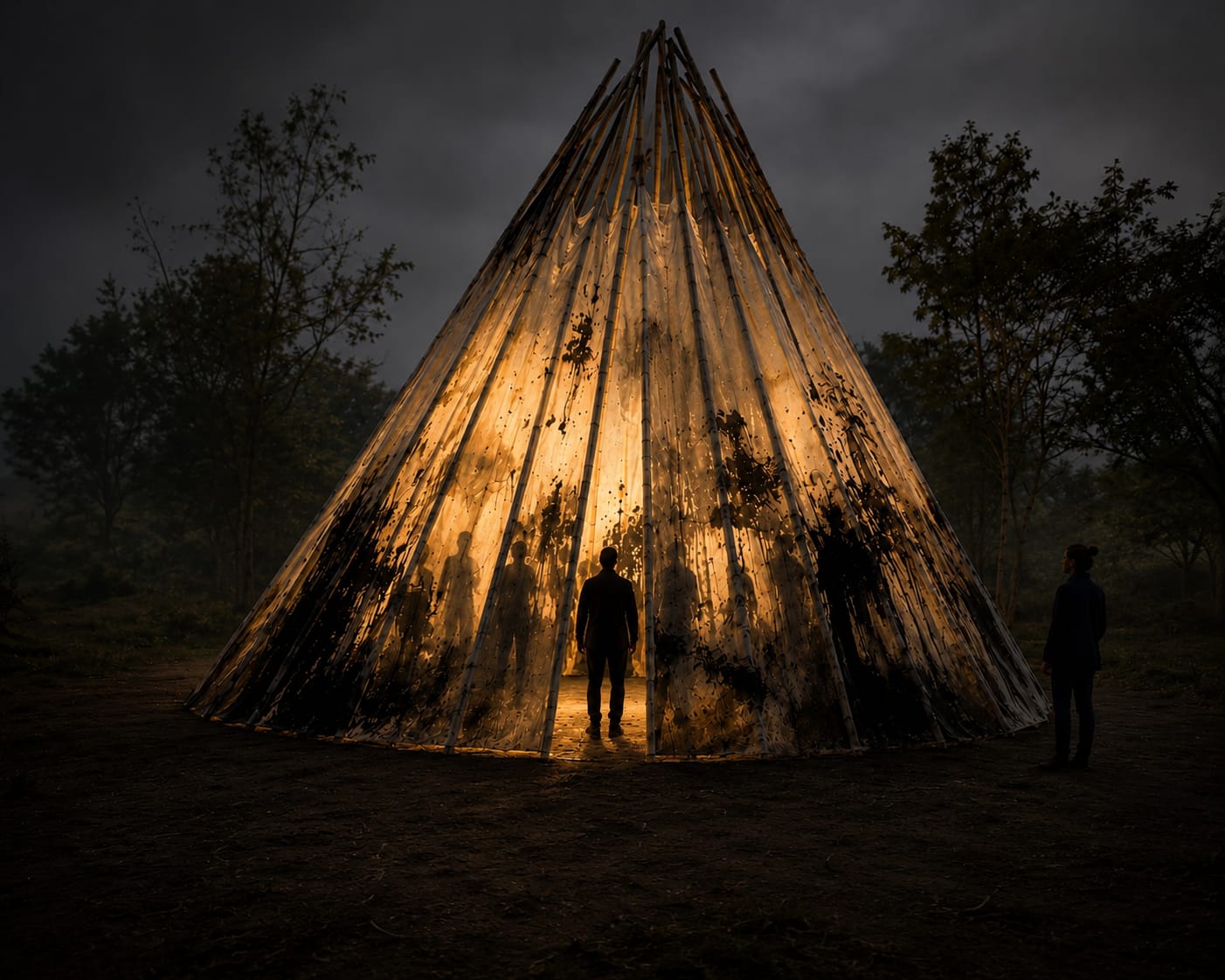 Pictorial architecture I. The work ceases to be a surface and begins to be constructed as an inhabitable territory.
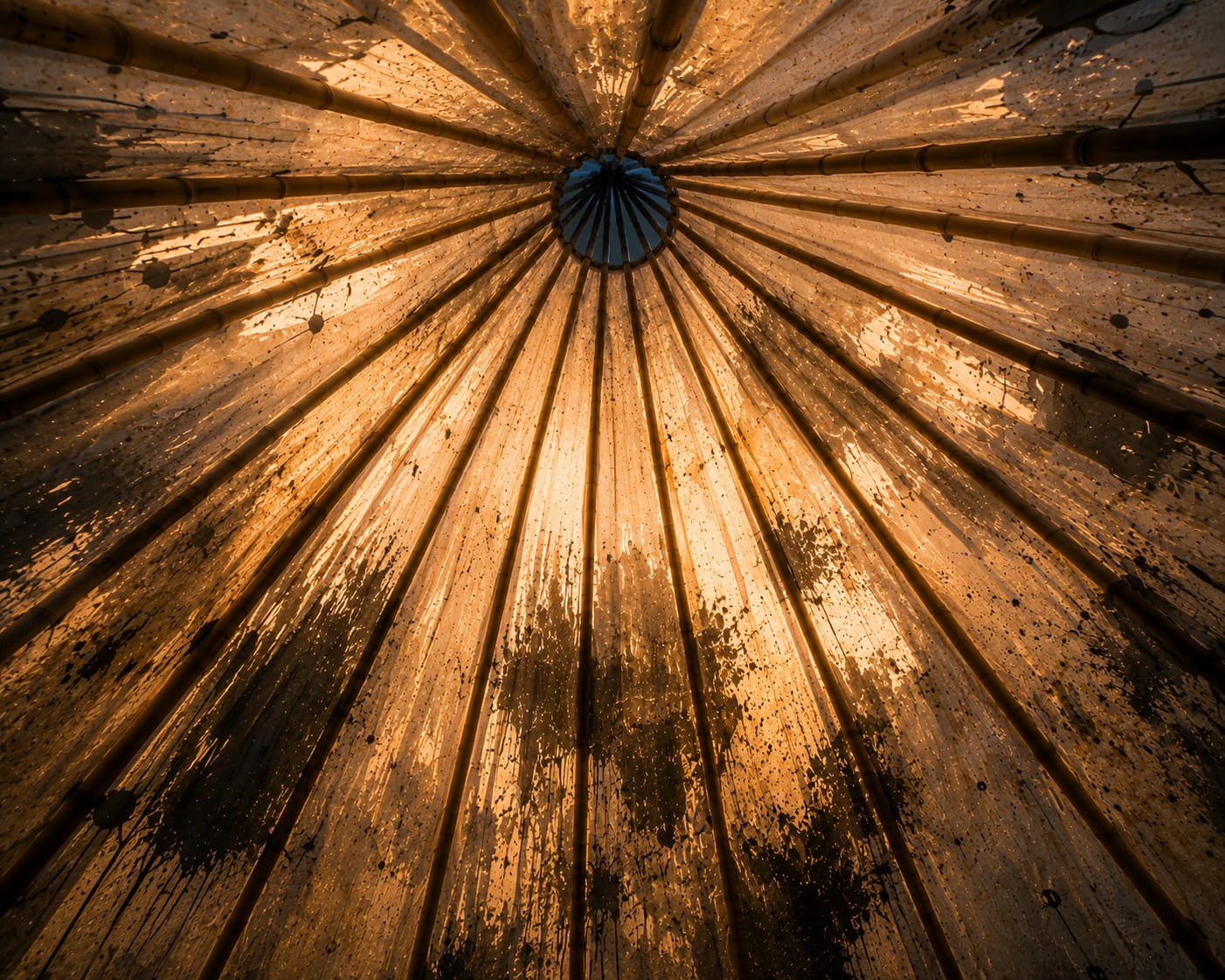 Pictorial architecture II. Membrane, light, and matter in tension within the space.
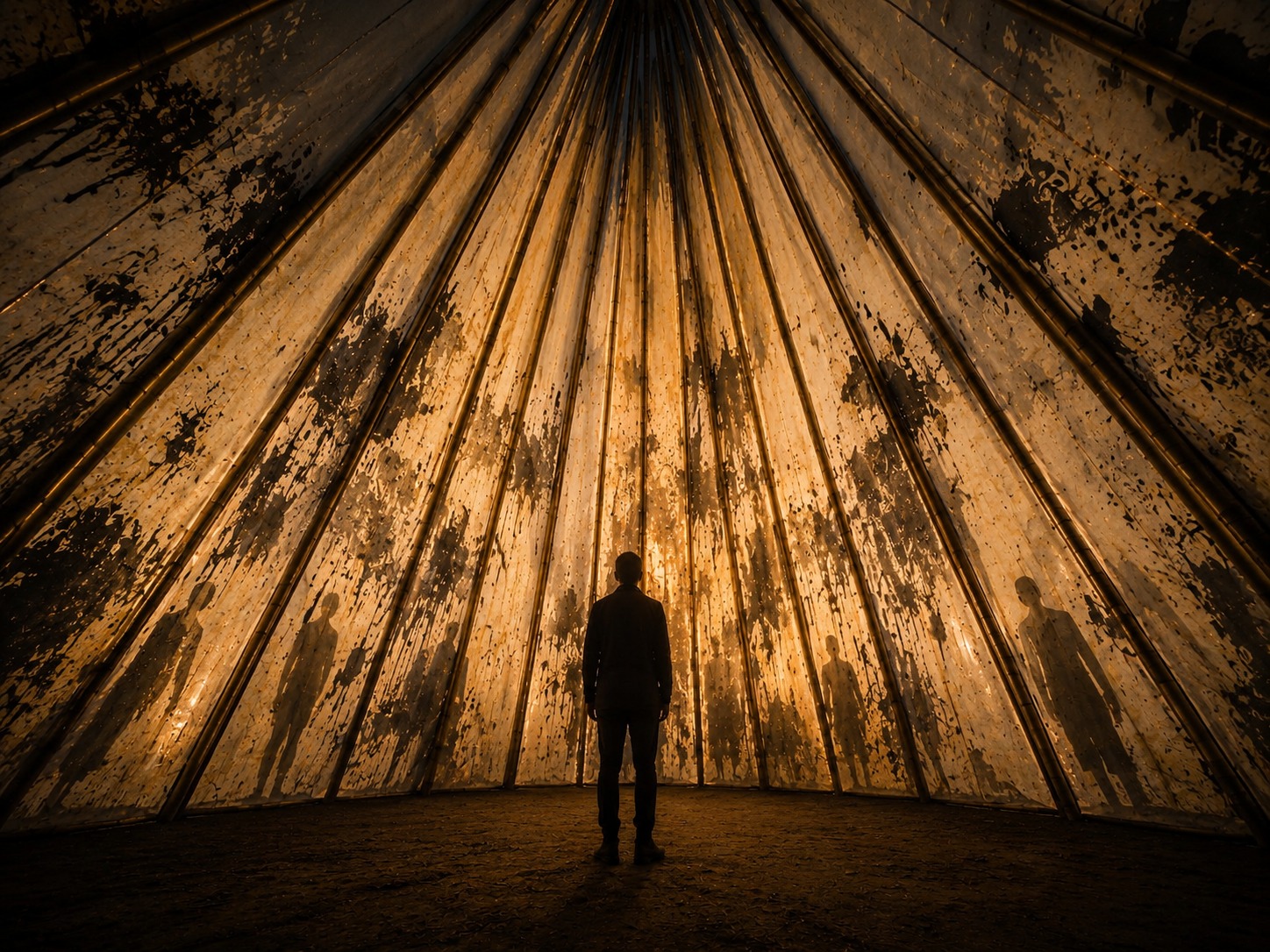 Pictorial architecture III. The body in front of a painting that is traversed, inhabited, and breathes.